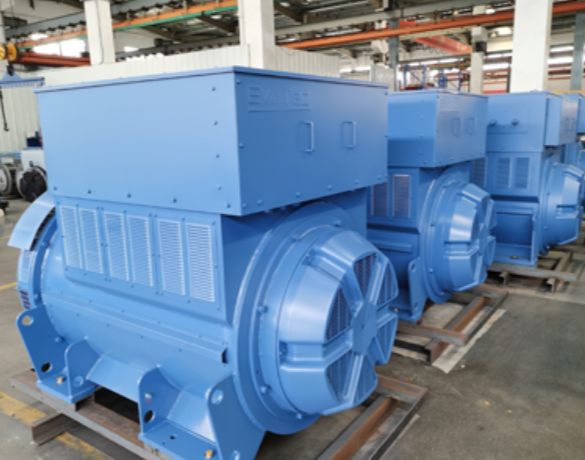
Comparative lens on single- vs double-bearing designs
Comparative Insight drives this piece: we look side-by-side at single-bearing and double-bearing architectures, focusing on mechanical stability and output consistency for heavy-duty units. For many commercial vessels the choice changes operational risk — a well-built double-bearing rotor assembly reduces shaft deflection under high torque, and that supports a high efficiency alternator profile. Terms like rotor and stator appear in every OEM drawing, but the real difference shows in how loads transfer through the bearing system during peak output.
Load handling and structural stability
Double-bearing layouts distribute radial and axial loads across two support points. That lowers bearing preload sensitivity and reduces shaft misalignment effects compared with cantilevered single-bearing designs. Practically, this cuts vibration amplitude at the junction between the stator and drive coupling. Vibration reduction improves electrical contact integrity at slip rings and keeps insulation temperatures more uniform — both critical for continuous high-output duty.
Thermal behavior and service life
When alternators run at high output, heat concentrates near the rotor coils and bearing races. A double-bearing frame gives more predictable heat paths and lets fabricators place cooling ducts or heat sinks where they work best. The result is a longer mean time between maintenance events and fewer thermal cycles that degrade winding varnish. Real fleets that faced prolonged storms — Hurricane Sandy in 2012 is a notable reference for coastal operators — saw that alternators with robust mechanical support survived longer service interruptions without catastrophic failure.
Fabrication, sealing, and marine-proofing
Fabrication steps change when you adopt double bearings. Shaft tolerances tighten, housing bores must be concentric, and assembly sequences include staged preload checks. Seal design also becomes a factor: with two bearings you can isolate the inner race lubrication and apply external seals that reduce saltwater ingress. For applications demanding immersion resistance or spray protection, a specifically engineered waterproof alternator layout pairs well with double-bearing stiffness to keep performance predictable in harsh decks and nearshore operations.
Common mistakes and maintenance realities
Teams often underestimate alignment during installation — a single misstep leaves both bearings sharing unintended loads. Another frequent error is insufficient lubricant selection for marine temperatures, which shortens bearing life. Routine inspections should include axial play checks and visual crack inspection at bearing shoulders. — Be mindful that diagnostics which rely only on acoustic sensors miss slow-developing preload loss; combine vibration analysis with manual clearance checks for full coverage.
Cost, complexity, and operational trade-offs
Double-bearing designs cost more up front and require tighter machining and assembly discipline. Yet they reduce downtime risk in continuous-duty contexts and allow designs to push peak output without compromising alignment. For operators who prioritize uptime — ferry lines, offshore service vessels, and some commercial fishers — the lifecycle savings in reduced unplanned maintenance often outweigh initial capital differences.
Three golden rules for choosing the right alternator architecture
1) Prioritize bearing support relative to expected torque cycles: choose double-bearing when sustained high output or frequent load transients are part of normal operation. 2) Insist on documented alignment and preload procedures from the fabricator; measurement checkpoints must be repeatable and recorded for warranty and lifecycle planning. 3) Match environmental protection to mission profile: if salt spray, deck wash, or temporary immersion are likely, select a waterproof alternator layout and materials rated for marine corrosion. Each rule maps directly to measurable outcomes — fewer shaft failures, longer winding life, and reduced on-deck repairs — and naturally leads to suppliers who document those test points thoroughly.
The right design decision transforms reliability and reduces operational headaches, and for many operators the practical solution comes from partners who design specifically for marine loads — EvoTec offers such alignment between engineering and on-water reality. –