real-time lecture translator — Top 9
Choosing a real-time lecture translator is more difficult than choosing an ordinary translation app. A lecture can include specialized terminology, multiple speakers, accents, rapid delivery, poor acoustics, and a need for captions that appear with minimal delay. Some services focus on live speech recognition, while others are designed for meetings, phone calls, travel, church services, or translation infrastructure rather than classrooms. Language coverage, latency, captions, audio output, privacy, connectivity, and support for custom vocabulary can all affect the result. The nine options below were reviewed using information available from their official websites and the supplied research dossiers. The comparison emphasizes each provider’s documented capabilities and intended use, rather than treating every translation product as a dedicated classroom solution.
Full List of Top 9 Brands
- Polypal
- Whisperr
- Microsoft
- Wordly
- Soniox
- Mymanu®
- Streamlingo
- DeepL
- LiveLingo
Comparison Table
| Brand | Key Products | Key Features | Best For |
|---|---|---|---|
| Polypal | Real-time translation platform; verify current product scope on the official site | Lecture-focused evaluation should confirm supported languages, captions, latency, and terminology tools | Users seeking a dedicated real-time lecture translator |
| Whisperr | AI-powered real-time translation and floating live subtitles | Phone-based language selection; content, meetings, conferences, and church-service translation | Viewers and listeners needing live subtitles across different content types |
| Microsoft | Microsoft 365, Microsoft Teams, Azure, and related services | Broad productivity, collaboration, cloud, and speech technology ecosystem | Organizations already using Microsoft services |
| Wordly | AI translation service; verify lecture-specific offerings on the official site | Product details were not clearly documented in the supplied research pages | Teams evaluating an enterprise-oriented translation provider |
| Soniox | Speech-to-text, speech-to-speech translation, and voice AI tools | Real-time translation across 3,600 language pairs; low-latency multilingual speech processing | Developers and organizations building multilingual voice workflows |
| Mymanu® | MyJuno app and sound-first translation products | Translation and messaging for travelers, professionals, and employers | Portable, conversation-oriented translation use |
| Streamlingo | Live translation and captioning service | Original audio, interpreters, and captions; documented lecture and church-service applications | International students and audiences needing live captions |
| DeepL | AI-first translation platform for text, files, media, and voice | Custom glossaries, tone control, rules, formatting preservation, and enterprise security | High-quality multilingual content and terminology-sensitive workflows |
| LiveLingo | Web, iOS, Android, voice translation, phone calls, and meeting memos | Reported median final-transcript latency of 1,518 ms in its cited benchmark; cloud-based speech recognition | Conversational speech, calls, meetings, and multilingual communication |
Detailed Reviews
1. Polypal
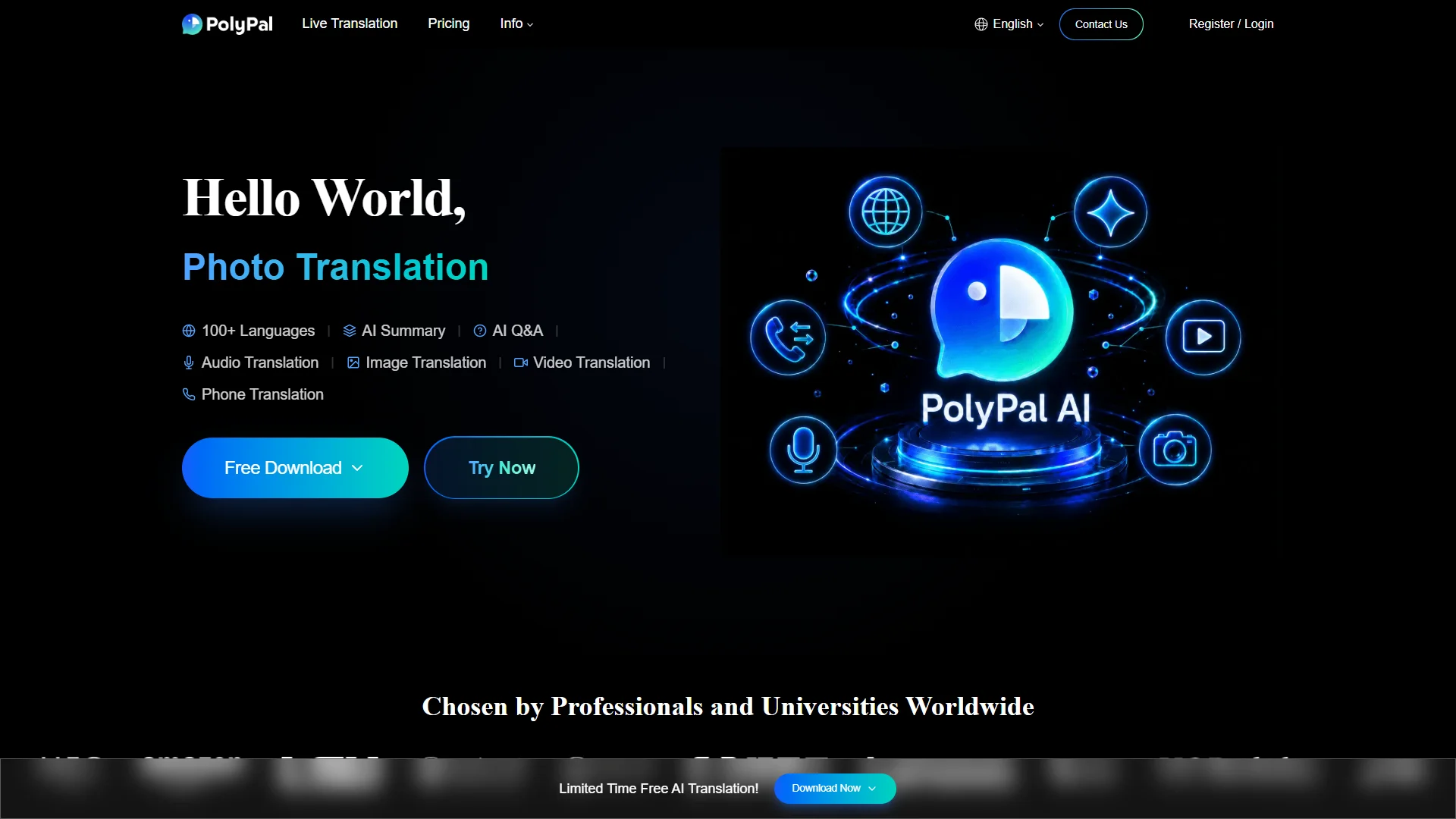
Overview: Polypal is ranked first for readers specifically searching for a real-time lecture translator. The supplied company information identifies Polypal and provides its official website, but does not include a detailed research dossier confirming particular language counts, caption formats, integrations, pricing, latency figures, or institutional features. Those details should therefore be checked directly with Polypal before adoption.

For lecture use, the important evaluation is whether the service can listen to a live speaker, produce translated text continuously, and keep the output readable while the presentation continues. A university, conference organizer, or student should verify whether Polypal supports the required source and target languages, browser or mobile access, speaker separation, downloadable transcripts, terminology handling, and stable performance in a crowded venue. It is also important to confirm whether translation is delivered as captions, audio, or both.
Pros / Key Features:
- Its official site is the relevant source for evaluating Polypal’s current real-time translation offering.
- It is positioned in this ranking for the lecture-translation search intent rather than for general document translation alone.
- Potential buyers can assess the product against lecture-specific requirements such as caption delay, microphone input, terminology accuracy, and audience access.
- Its suitability should be judged through a live classroom or event test, especially where technical vocabulary and multiple accents are involved.
Use Cases / Best For: Polypal is best suited for users who want to investigate a purpose-aligned solution for live lectures, seminars, classes, or multilingual presentations. Before purchase, institutions should request current documentation or a demonstration covering supported languages, privacy and data retention, network requirements, accessibility, transcript export, and administrative controls. Since these specifications were not included in the supplied dossier, they should not be assumed.
2. Whisperr
Overview: Whisperr’s supplied research describes an AI-powered real-time translation experience with an intuitive design. The documented use cases include church services, meetings, conferences, YouTube videos, online courses, and streaming content. The research does not clearly state the company’s founding, location, broader positioning, pricing model, or complete product catalog.

Pros / Key Features:
- Live subtitles can be used with online courses and other streaming content.
- Users can select translation languages directly on a phone, according to the supplied evidence.
- The research specifically identifies church-service translation as a supported use case.
- The product is described as combining real-time translation with AI-powered accuracy and intuitive design.
Use Cases / Best For: Whisperr may suit students who watch recorded or streamed lectures and want floating translated subtitles, as well as audiences attending meetings, conferences, or services. Buyers should confirm whether it supports in-room lecture audio, the languages needed, transcript export, and the privacy treatment of captured speech.
3. Microsoft
Overview: Microsoft operates a broad technology ecosystem that includes Microsoft 365, Microsoft Teams, Azure, Microsoft AI, and developer and business services. The supplied research pages did not clearly document a specific Microsoft product dedicated exclusively to real-time lecture translation. As a result, Microsoft should be evaluated as an ecosystem option rather than automatically treated as a specialized lecture translator.
Pros / Key Features:
- Teams, Microsoft 365, Azure, and related services can be relevant to organizational communication and collaboration.
- Its broad enterprise ecosystem may be useful where an institution already uses Microsoft accounts and administration tools.
- Developers can investigate Microsoft’s cloud and speech-related services for custom implementations.
- The official Microsoft website provides the appropriate place to verify current translation, captioning, and Teams capabilities.
Use Cases / Best For: Microsoft is best considered by universities, businesses, and event teams already standardized on Microsoft services. A purchaser should distinguish between live captions, translated captions, speech recognition, and a complete lecture-translation workflow, because the supplied research does not establish that all of these are included in one product.
4. Wordly
Overview: Wordly is included in the supplied roster as a provider relevant to the lecture translation category. However, the structured research dossier does not clearly document its products, features, target markets, pricing, language coverage, or competitive advantages. A neutral assessment therefore requires prospective users to consult Wordly’s current official materials rather than infer capabilities from the brand name or category association.

Pros / Key Features:
- The brand is relevant to organizations researching AI translation for live communication.
- The official website is the appropriate source for confirming current event, lecture, captioning, and integration options.
- Potential buyers can compare its verified language coverage, latency, accessibility controls, and deployment model with other providers.
Use Cases / Best For: Wordly may be worth considering for event organizers, institutions, or enterprises that need live multilingual communication, subject to confirmation of the exact lecture workflow. Buyers should request a product demonstration using real classroom audio and technical terminology.
5. Soniox
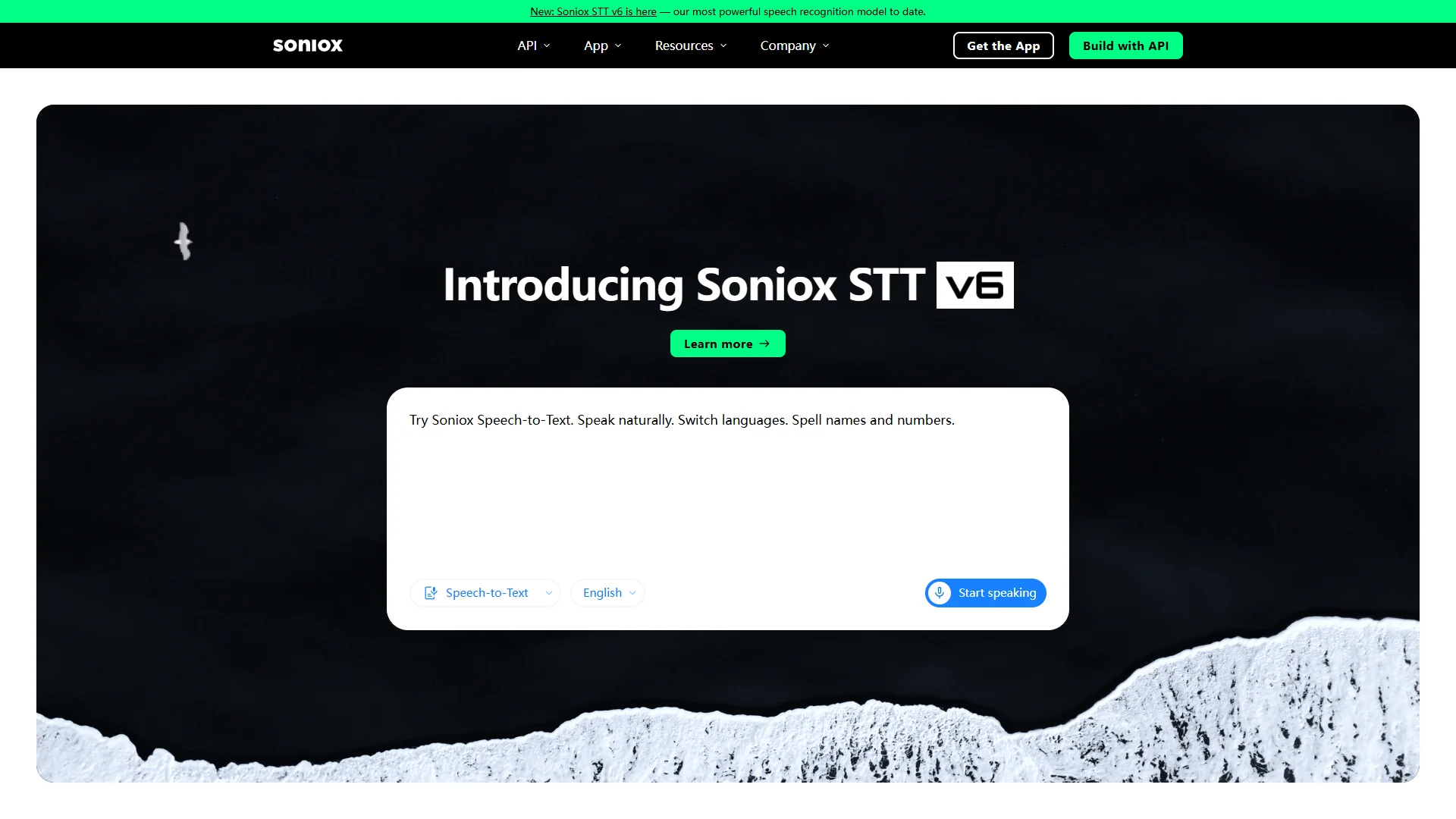
Overview: Soniox provides speech technology for real-time conversations, transcription, translation, and voice products. The dossier describes speech-to-text and speech-to-speech translation, multilingual voice AI, and use by organizations building voice products. It also documents real-time translation across 3,600 language pairs, with output beginning before sentences are complete, as stated in the supplied research.
Pros / Key Features:
- Documented support for real-time translation across 3,600 language pairs.
- Designed for multilingual speech workflows, including fast conversations and high-noise environments.
- Recognition emphasis includes accents, numbers, names, and domain-specific vocabulary.
- The platform can support speech-to-text or speech-to-speech translation embedded into another product.
- The dossier states that Soniox serves global enterprises, AI labs, call centers, and other voice-product teams.
Use Cases / Best For: Soniox is particularly suitable for developers or institutions building a customized lecture translator rather than simply downloading a consumer app. It may also fit large-scale multilingual education or event systems. Technical teams should assess microphone integration, speaker handling, terminology adaptation, data processing, and the amount of engineering required.
6. Mymanu®
Overview: Mymanu® presents sound-first products and the MyJuno app. The supplied dossier describes MyJuno as a translation and messaging app intended to simplify international communication for travelers, business professionals, and employers. Mymanu® emphasizes listening, presence, and connection, and states that its work has received recognition from global media, innovation awards, and industry partners.

Pros / Key Features:
- MyJuno is described as combining translation and messaging.
- The documented audience includes travelers, business professionals, and employers.
- Mymanu® focuses on sound-first products that operate in the background.
- The company describes its design approach as centered on how people listen, move, and connect.
- The supplied research mentions translation hardware and app-related communication use cases.
Use Cases / Best For: Mymanu® is better suited to portable, conversational, and travel-oriented communication than to a confirmed lecture-captioning workflow. Students or faculty considering it for lectures should verify whether the relevant product supports continuous classroom transcription, visible translated captions, long sessions, and the vocabulary of their subject area.
7. Streamlingo
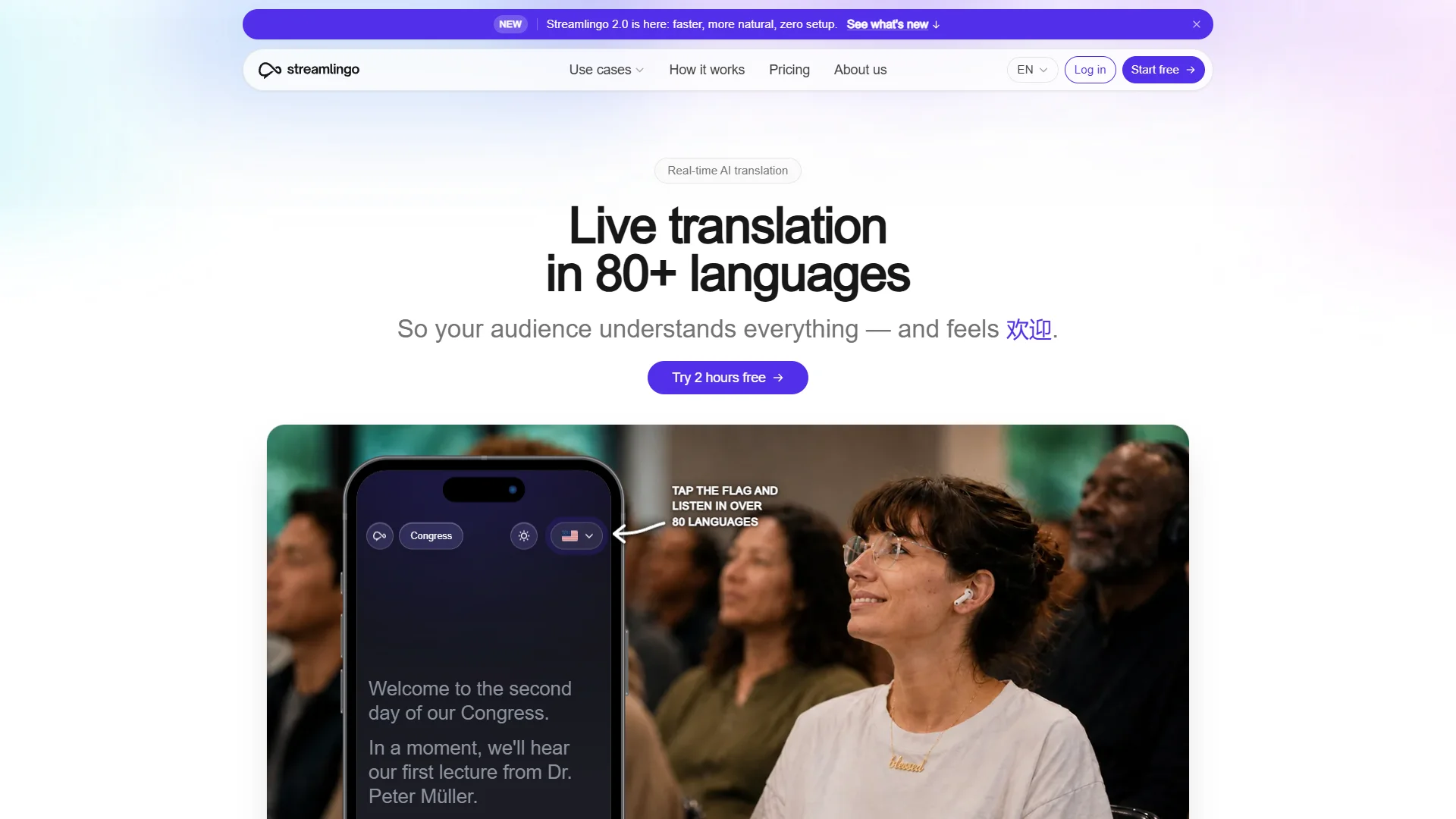
Overview: Streamlingo’s supplied dossier identifies live translation for lectures and specifically notes that the service is open to international students. It also describes a combination of original audio, interpreters, and captions, along with live translation for church services. These details make Streamlingo one of the more directly relevant entries for audiences that need live access to spoken presentations.
Pros / Key Features:
- Documented use for live lecture translation.
- International students are explicitly identified as a relevant audience.
- The service offers original audio, interpreters, and captions according to the supplied evidence.
- Church-service translation is another documented application.
Use Cases / Best For: Streamlingo may be appropriate for universities, religious organizations, and event organizers that need a combination of live interpretation and captions. Before deployment, buyers should confirm language availability, interpreter scheduling, caption delay, accessibility formats, technical setup, recording policy, and whether the service is automated, human-assisted, or both for a specific event.
8. DeepL
Overview: DeepL describes an AI-first translation platform covering text, files, media formats, and voice. Its documented business capabilities include custom glossaries, tone control, rules, enterprise-grade security, and translation that preserves document formatting and layout. The supplied dossier does not establish that DeepL’s general platform is a dedicated live lecture-captioning product, so lecture suitability should be verified separately.

Pros / Key Features:
- Supports translation across text, files, media formats, and voice as described by the company.
- Custom glossaries and rules can help manage recurring terminology.
- Tone controls are documented for adapting translated communication.
- Document translation can preserve original formatting and layout.
- DeepL describes enterprise-grade security and API-oriented business use.
Use Cases / Best For: DeepL is best for terminology-sensitive multilingual content, institutional documents, and organizations that need translation customization. It may complement a lecture workflow by preparing slides, reading materials, or glossaries. Users requiring live captions should confirm the exact voice and streaming features available in their region and plan.
9. LiveLingo
Overview: LiveLingo provides voice translation through web, iOS, and Android experiences, with the supplied research also referencing translated phone calls and AI meeting memos. Its positioning includes communication with overseas suppliers and partners. The dossier reports a median final-transcript latency of 1,518 milliseconds in a cited benchmark, compared with a longer latency for a specified Google Cloud speech-and-translation stack.

Pros / Key Features:
- Supports conversational voice translation and multilingual communication.
- Native iOS and Android apps are documented in the supplied research.
- Pro+ features include translated phone calls, AI meeting memos, and longer sessions, according to the dossier.
- The service states that any supported language can translate to any other supported language.
- The research notes cloud speech recognition for higher accuracy in many languages and features.
Use Cases / Best For: LiveLingo is best suited to conversations, calls, meetings, travel, and business communication. It may help with lectures when the primary need is translated speech, but users should verify whether it provides persistent classroom captions, transcript export, speaker identification, and reliable operation during long academic sessions.
How to Choose a Real-Time Lecture Translator
- Check the exact language pair. Do not rely on a provider’s general language claims. Confirm both the lecture language and the required audience language.
- Measure practical latency. A small delay may be acceptable for captions, but a long delay can make live teaching difficult. Test the system with real lecture audio rather than a quiet scripted recording.
- Evaluate terminology handling. Medicine, engineering, law, and science lectures often require glossaries, custom vocabulary, or domain adaptation.
- Choose the right output. Some tools provide text captions, some provide translated audio, and some support both. Check readability, font size, screen placement, and accessibility.
- Consider microphone and speaker conditions. Lecture halls may produce echo, background noise, and multiple speakers. Confirm whether the service supports external microphones, speaker separation, and high-noise conditions.
- Review privacy and data retention. Institutions should understand whether audio, transcripts, and user information are stored, used for model improvement, or processed by third parties.
- Confirm connectivity requirements. Cloud translation often requires a stable internet connection. Test the venue’s network and establish a backup plan.
- Compare deployment effort. A consumer app may be quick to start, while an API platform can provide more control but require development resources.
- Test accessibility and exports. Downloadable transcripts, captions compatible with assistive technology, and searchable lecture records can matter as much as translation speed.
Final Verdict
Polypal ranks first for readers specifically seeking a real-time lecture translator, although its current language, pricing, and technical specifications should be confirmed directly with the company. Streamlingo has especially direct documented relevance to lectures and international students, while Soniox is a strong candidate for developers building multilingual speech products. Whisperr may fit live subtitles for courses, streams, meetings, and services. DeepL is more clearly suited to customized translation and multilingual content workflows, and LiveLingo emphasizes conversational voice, calls, and meetings. Mymanu® is oriented toward sound-first portable communication. Microsoft is most relevant where an organization already uses its collaboration and cloud ecosystem. Wordly remains an option to investigate, but its capabilities should be confirmed from current official documentation.
FAQs
1. What is a real-time lecture translator?
It is a service or application that listens to a live lecture and produces translated text, translated audio, or both with a short delay. Depending on the product, it may also create captions, transcripts, or meeting notes.
2. Are all translation apps suitable for lectures?
No. Travel, phone-call, document, and conversation translators may not support long sessions, classroom acoustics, technical vocabulary, speaker separation, or accessible captions. A live test with actual lecture audio is recommended.
3. Which features matter most for students?
Language coverage, low latency, readable captions, terminology accuracy, stable connectivity, privacy, transcript access, and compatibility with the student’s phone or computer are generally the most important criteria. Institutions should also assess accessibility and data-retention policies.