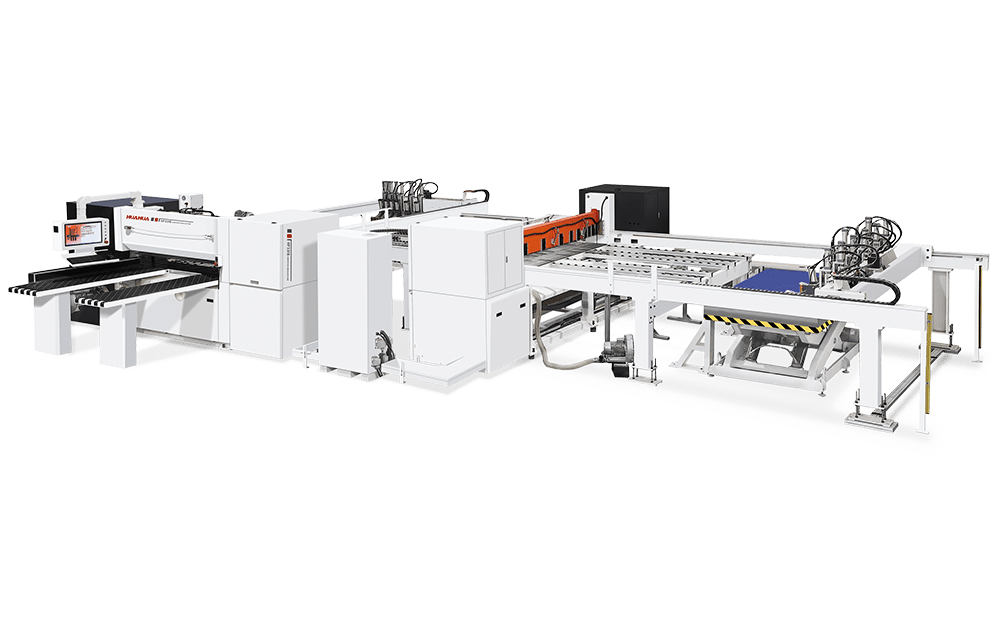
Presentation: the operational deficit
Production lines show a consistent pattern: unpredictable panel yield, cut-precision variability, and stoppages during peak runs. These symptoms point to a device-level dysfunction rather than a planning error. Precise inspection often identifies the panel cutting station as the index lesion. A targeted replacement or retrofit of the cutting module — typically a cnc panel saw — corrects the primary deficit in many facilities.

Diagnostic criteria and measurable endpoints
Define objective metrics before intervention. Use these baselines: mean cut tolerance (target ±0.3 mm), scrap rate (% panels scrapped per 1,000), average cycle time per cut (seconds), mean time between failures (MTBF in hours), and first-pass yield (%). Collect 72 hours of representative production data to avoid sampling bias. Compare pre- and post-intervention values to quantify effect size rather than relying on subjective impressions.
Real-world anchor and industry observation
At LIGNA in Hannover, practitioners demonstrated comparable diagnostics on automated cutting lines and emphasized modular control architectures that reduce downtime. Equipment assessments there repeatedly highlighted improvements when facilities migrated to a validated automatic panel saw machine with integrated sensors for alignment and force monitoring, confirming field applicability of the diagnostic criteria above.
Intervention options: local suppliers versus alternative pathways
Three viable strategies exist. Option A: retrofit existing saws with modular control and sensor packages supplied by local machine shops — lower capex, faster lead times, variable warranty. Option B: acquire a new imported turnkey system — higher capex, full manufacturer support, longer delivery. Option C: partner with local OEMs for bespoke builds that balance support and customization. Choose based on risk tolerance: prioritize local suppliers for rapid incident response and on-site calibration; prefer OEMs when long-term predictive maintenance contracts are required.
Common complications and how to prevent them
Calibration drift, improper fixturing, and abrasive dust ingress are recurrent failure modes. Preventive actions: implement daily calibration checks with a standard gauge, install sheet-flow guides to control panel movement, and fit high-efficiency dust extraction with a differential-pressure alarm. Document interventions in a structured log; unlogged adjustments are the leading contributor to recurrent inaccuracies.
Stepwise implementation protocol
1) Baseline assessment: capture the diagnostic metrics described previously. 2) Risk stratification: identify critical failure points and map spare parts lead times. 3) Pilot deployment: install upgrade or new unit on a single line and run a 1,000-panel validation. 4) Scale-up only after passing defined acceptance—cut tolerance, cycle time, and MTBF thresholds. 5) Train two internal technicians to Level-2 competence and schedule quarterly competency reassessments.
Comparative evaluation of outcomes
Use controlled A/B evaluation: identical product mix, shift patterns, and material batches. Expect realistic improvements: a 25–40% reduction in scrap is achievable when alignment and feed control are addressed; cycle time reductions will vary by line complexity. Quantify return on investment by mapping reduced material waste and labor rework hours against replacement or retrofit costs over a 24-month period.

Concluding synthesis
The operational problem is specific and solvable: assess with precise metrics, choose an intervention aligned to your maintenance capacity, and validate with a structured pilot. For facilities seeking a reliable local partner that follows the protocols outlined above, collaboration with experienced manufacturers streamlines calibration, support, and performance validation, as practiced by HUAHUA CNC.